Dispatch #115 White Lesbian Age 71 Considers: How Much Suffering Is Required of Palestinians?
Updated: Aug 31, 2025
Nov. 22nd 2023
1035 Days Since Inauguration of First Woman Vice-President
64 Days Until the 2024 Presidential Primaries Begin
516 Days Since Supreme Court Ruled Women Don’t Have Human Rights
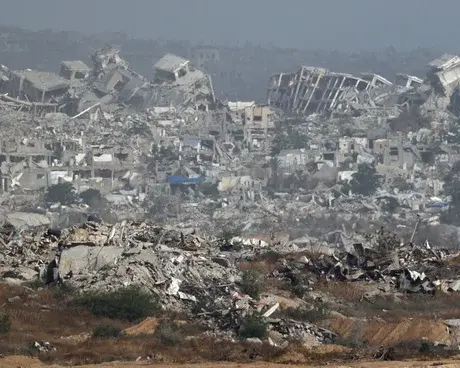
More than 14,00 Palestinians are dead and more than 34,000 are wounded; more than 40% of the dead and wounded are children. Thousands lie under the rubble
Barefoot and weeping, Khaled Joudeh, 9, hurried toward the dozens of bodies wrapped in white burial shrouds, blankets and rugs outside the overcrowded morgue. “Where’s my mom?” he cried. “I want to see my mom.” “Where is Khalil?” he continued, barely audible between sobs as he asked for his 12-year-old brother. A morgue worker opened a white shroud, so Khaled could kiss his brother one final time.
Then, he bid farewell to his 8-month-old sister. Another shroud was pulled back, revealing the blood-caked face of a baby, her strawberry-red hair matted down. Khaled broke into fresh sobs as he identified her to the hospital staff. Her name was Misk, Arabic for musk. “Mama was so happy when she had you,” he whispered, gently touching her forehead, tears streaming down his face onto hers.
She was the joy of his family, relatives later said — after three boys, his parents were desperate for a girl. When she was born, they said, Khaled’s mother delighted in dressing Misk in frilly, colorful dresses, pinning her tiny curls in bright hair clips.
Through his tears, Khaled bid farewell to his mother, father, older brother and sister, their bodies lined up around him. Only Khaled and his younger brother, Tamer, 7, survived what relatives and local journalists said was an airstrike on Oct. 22 that toppled two buildings sheltering their extended family. A total of 68 members of the Joudeh family were killed that day as they slept in their beds in Deir al Balah, in central Gaza. www.nytimes.com/2023/11/18/world/middleeast/gaza-children-israel.html
Three-year-old Ahmad struggles in a hospital bed recovering from surgery. He is restless, crying -- the hospital has run out of pain medication -- and cannot be comforted by his uncle Ibrahim who says the boy keeps asking to go for a walk. Ibrahim says Ahmad does not know that his legs were blown off during a November 13th Israeli bombing on the Nuseirat refugee camp. On 7 October Ahmad survived an Israeli bombing that killed his parents and most of his extended family. www.aljazeera.com/news/2023/11/16/in-gaza-ahmad-lost-his-family-then-his-legs-to-israels-bombing
Dr Fady Joudah is an award-winning Palestinian American writer, poet, and physician. He has translated several collections of poetry from Arabic into English, including work by the renowned Palestinian poet Mahmoud Darwish. Although Dr. Joudah lives in Houston, more than 50 or 60 members of his extended family have been killed by Israeli airstrikes in Gaza since October 7th. During an interview on Democracy Now, Dr. Joudah said:
The situation [Gaza] is unspeakable and will remain unspeakable, I think, for generations and decades, has been a culmination of the Palestinian experience for a hundred years, since the British Mandate and the beginning of settler colonialism with Zionist immigration into Palestine. It is really beyond words to describe what it means to be a Palestinian in this moment, the accumulation of multigenerational trauma and memories that activates in each one of us previous memories we’ve tried overcome with hope and a flair for life and for freedom, only to find that there is always some horrific episode that reminds us that we are on this Earth in this time, liable to be massacred and lied about. www.democracynow.org/2023/11/9/fady_joudah_family_killed_by_israel
“A Palestinian Meditation in a Time of Annihilation Thirteen Maqams for an Afterlife” By Fady Joudah 1 November 2023 Excerpts. https://lithub.com/a-palestinian-meditation-in-a-time-of-annihilation/.
What forgetfulness, what fatigue and ennui will afflict the pro-Palestinian American public after the massacre? Will Palestinians return to their demoted status in the public sphere, as subjects of the temporality of Zionist moral illumination?
But I have a more daring question. The Israeli people at large, the Jewish communities outside Israel that identify strongly or faintly, defensively or hawkishly with Israel, the mainstream Western world, and all expressions of Zionism, what do they want from Palestinians?
In the best-case scenario, I do not think they really know. I am terrified to think that this relentless progression of dispossession and carnage against the Palestinians has reached irreversible, irrational levels. In my dark hours, which increase by the year, I wonder if Israel is unable to examine or defuse its impulse to test the limits of genocide against the Palestinians—because it has not been able to process the genocide that the Nazis committed against the Jewish people. A genocide that was made possible by centuries of European antisemitism, pogroms, silence, and looking away.
If this is the path we are on, what then, as this path reaches its fulminant stage? Aren’t we there yet? The Palestinians do not need to fully identify, in the flesh, with the Jewish experience of genocide. Israel does not need to experience the completion of a genocide on another people to truly forgive Europeans for what they have done to the Jewish people.
- - - - - - - - - - - - - - - - - -
Through advanced technology and digital surveillance, along with collaborators, Israel owns Palestinian lives and bodies, their right to movement, to privacy, to childhood, to dreams. Palestinian children are criminalized as adults at the age of 12, for example. Israel works hard to maintain near-total control over its power to punish Palestinian bodies, should the state deem any of those bodies disobedient or rebellious. The punishment is often brutal, barbaric. Palestinians are confined to narrow spaces, and in the case of Gaza, subjected to a siege that has controlled their caloric intake, their access to healthcare and basic hygiene products, including feminine products.
What makes a state obsess over its desire to totally dominate a whole people, to own their bodies between servility and expulsion? What makes an overwhelming majority of a people consign another to oblivion, cut them off from the outside world for decades, mutilate their image and their being into superfluous nonbeings? What people obsess over severing another people from their olive trees? How deadly the olives?
Dr. Joudah begins A Palestinian Meditation in a Time of Annihilation with:
Hiba Abu Nada, 32, wrote and published her final poem ten days before Israeli bombs killed her and many others on October 20, 2023, in Gaza. She had a B.A in organic chemistry and a master’s degree in clinical nutrition. In her short life she managed to publish one novel, Oxygen is Not for the Dead. The speaker in Abu Nada’s final poem is an inner I, probably the voice of God welling up inside. Here is an excerpt:
I shelter you
and the children who
are sleeping
as chicks in the lap
of their nest
they don’t walk
in their dreams
because death
towards the house
walks
….
I shelter you
from wound and woe,
and with seven verses
I shield
the taste of orange
from phosphorus,
the color of clouds
from smoke.
Dr. Joudah concludes his essay by returning to Hiba Abu Nada:
Gift laden with dew. Hiba Abu Nada wrote her final post on social media ten days after she wrote her final poem, hours before she was killed. The movement between the two texts is haunting, unforgettable. The God within and the God above:
Each of us in Gaza is either witness to or martyr for liberation. Each is waiting to see which of the two they’ll become up there with God. We have already started building a new city in Heaven. Doctors without patients. No one bleeds. Teachers in uncrowded classrooms. No yelling at students. New families without pain or sorrow. Journalists writing up and taking photos of eternal love. They’re all from Gaza. In Heaven, the new Gaza is free of siege. It is taking shape now.
Hiba Kamal Abu Nada was a Palestinian poet, novelist, and nutritionist. Her novel Oxygen Is Not For The Dead won second place in the Sharjah Award for Arab Creativity in 2017. On 20 October 2023, she was killed along with her son by an Israeli airstrike on her home in Khan Yunis.


Comments